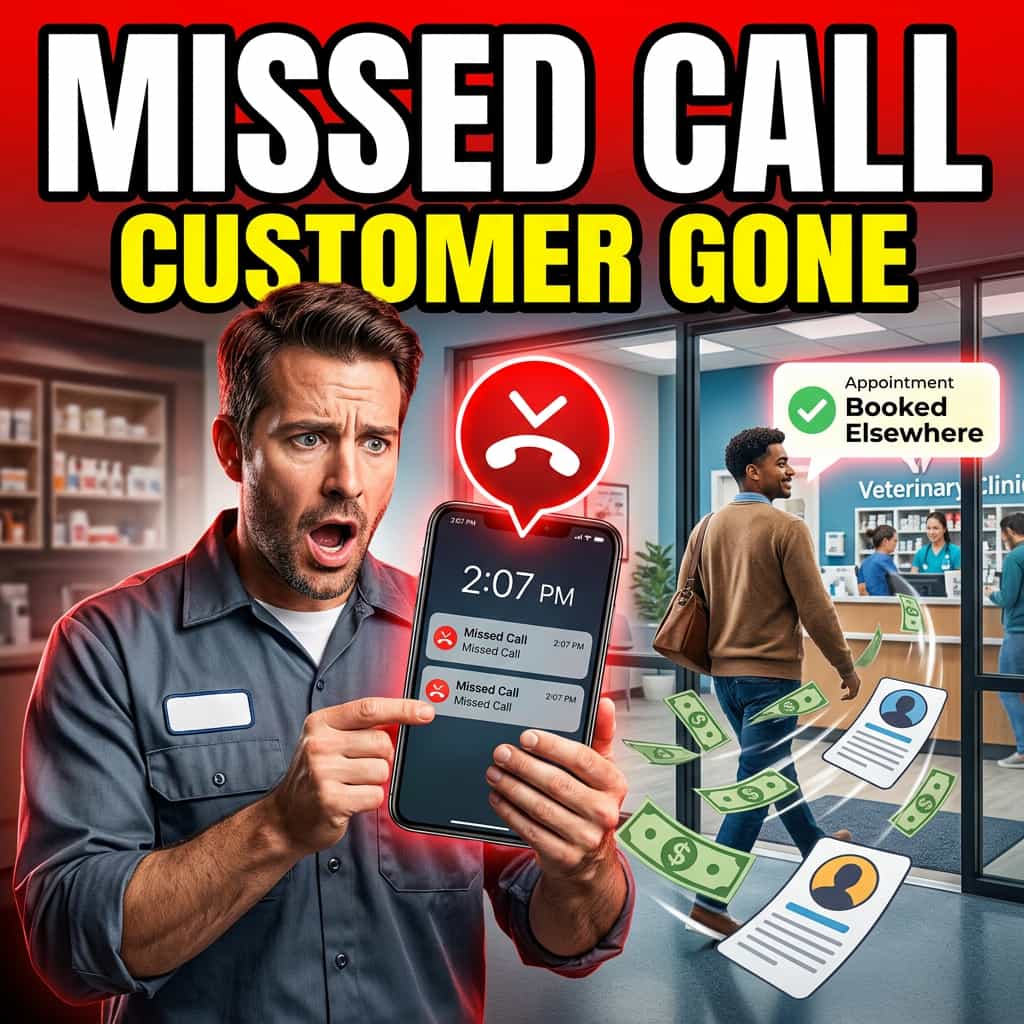
It's Tuesday, 2pm. You're mid-colour, hands covered in dye, scissors on the bench. The phone rings. By the time your apprentice picks it up, the caller has already hung up. You think: she'll ring back later.
She won't.
She is, right now, scrolling Google for the next salon on the list. By 2:07pm she has booked somewhere else. She isn't angry. She isn't disappointed. She just needs a haircut and you didn't answer.
This isn't a feeling. It's one of the most-cited findings in 30 years of marketing research — and the same thing is happening to vets, dentists, plumbers, cafés taking phone bookings, and one-person accounting firms across Australia, every single day.
The 2026 Small Business Missed Call Revenue Study by PCN found that small businesses miss between 25% and 60% of inbound calls. That is a wide range — because honest data has ranges, not made-up single numbers — but the lower end means one in four customers calling you never reaches a person.
What happens next is the part most owners get wrong.
Why your customer doesn't call back
In 1995, Susan Keaveney published a study in the Journal of Marketing called Customer Switching Behavior in Service Industries. She interviewed more than 500 real customers and mapped over 800 reasons people walked away from a service business. One of the biggest categories: not being able to reach the business when they needed to.
Seven years later, three researchers — Zohar, Mandelbaum, and Shimkin — published Adaptive Behavior of Impatient Customers in Tele-Queues in Management Science. Their finding, in plain language: when a customer can't tell whether they're making progress on hold, they stop waiting. The phone is not patient like email. The caller is right there, in real time, deciding every second whether you're worth waiting for.
Put the two together and you get the answer to "why didn't she ring back?". She didn't ring back because she didn't have to. The salon down the road answered. Your competitor is now her hairdresser.
What we can actually stand behind
There are a lot of scary numbers floating around about missed calls. Honestly, most don't pass a basic source check. You'll see "67% switch to a competitor" or "85% never call back", usually traced to a vendor blog citing another vendor blog citing a third vendor blog. So we're sticking with what's defensible:
- The PCN 2026 study, which synthesises academic research, consumer surveys, and industry datasets, puts the missed-call rate for SMBs at 25%–60%, depending on industry and time of day.
- The same study cites a 2024 audit of 85 small businesses across 58 industries: only 37.8% of calls were answered by a live person. The rest went to voicemail or rang out.
- After-hours is worse. A meaningful share of calls — roughly 20–40% in service industries — arrive outside 9-to-5. Almost no Australian small business is staffed for those hours.
That's the honest picture. Not everything is leaking. But enough is.
The maths, in plain English
Here's the formula PCN uses, stripped of jargon:
Missed calls × how often you'd book one × what one job is worth = money walking out
Pretend you're a mobile dog groomer in Sydney. You take 10 booking calls a day. You miss 25% — so 2 or 3. Of the ones you answer, you book about 30%. An average groom is $90.
2.5 × 0.30 × $90 × 365 ≈ $24,600 a year.
That's not a number we invented. That's your assumptions in your business, multiplied. If your average job is $400 instead of $90, the same maths gives over $109,000.
Missing two calls a day is not a small problem. It's a salary, a renovation, or a year of school fees.
What you can actually do this week
This is the part most posts skip in favour of selling you a $300/month AI receptionist. You may not need one. Here's the order to think about it:
1. Audit (free, 10 minutes).
Look at your phone log for last week. Count the missed calls. Multiply by your average job value. Multiply by 0.25 — a conservative guess at how many would have booked. That's last week's leakage. It will probably surprise you.
2. One boring fix (under $20 a month).
Set up an automatic SMS that fires the moment you miss a call. Something like: "Hi, this is Sarah from Petersham Pups. Just saw I missed your call — what time can I ring you back?" Most Australian phone providers offer this. It catches roughly half the people who would otherwise have rung the next number on the list.
3. Have somebody answer when you can't.
If you're a tradie on a job, forward your phone — to a partner, an Australian-based virtual receptionist (around $30–60 a month), or yes, an AI answering service. Pick whichever fits your business and your budget. The point is somebody answers.
You can spend $0, $30, or $300. The mistake is spending nothing and doing nothing.
The bigger picture
You opened your business to do good work. Nobody told you that the phone — that ordinary thing on your bench — is the most expensive marketing channel you own. The owner of the salon, dental, café, or panel-beating shop who answers first, on average, wins. That's it. That's the whole secret.
Next week we'll cover the free, boring thing you can do tomorrow morning to find out exactly which of your missed calls came from your $400 Google Ads spend last month. Spoiler: it's probably most of them.
If you want more compounding fixes like this, see why Australian SMEs running boring AI wins are growing 2.8x faster than the rest. If you've not started anywhere yet, the post on where to start with one task is the entry point.
George Smith, Founder of PRODUCT3.